Specify that the SCIP (Solving Constraint Integer Programs) software should be used to solve a conservation planning problem (Achterberg et al. 2008, Achterberg 2009). This function can also be used to customize the behavior of the solver. It requires the scip package to be installed.
Usage
add_scip_solver(
  x,
  gap = 0.1,
  time_limit = .Machine$integer.max,
  presolve = TRUE,
  threads = 1,
  first_feasible = FALSE,
  verbose = TRUE,
  control = list()
)
Arguments
- x
problem()ormulti_problem()object.- gap
numericvalue denoting the optimality gap. This gap is relative and expresses the acceptable deviance from optimality. For example, a value of 0.01 will result in the solver stopping when it has found a solution within 1% of optimality. Additionally, a value of 0 will result in the solver stopping when it has found an optimal solution. The default value is 0.1 (i.e., 10% from optimality).- time_limit
numericvalue denoting the time limit (seconds) for generating solutions. The solver will return the current best solution when this time limit is exceeded. The default value is the largest integer value (i.e.,.Machine$integer.max), effectively meaning that solver will keep running until a solution within the optimality gap is found.- presolve
integervalue indicating how intensively the solver should try to simplify the problem before solving it. Available options are: (-1) automatically determine the intensity of pre-solving, (0) disable pre-solving, (1) conservative level of pre-solving, and (2) very aggressive level of pre-solving . Defaults to 2.- threads
integervalue denoting the number of threads to use during optimization. Broadly speaking, we recommend settingthreadsto be no higher than the number of computational cores minus one or two (e.g.,threads = parallel::detectCores(TRUE) - 2). This is because settingthreadsto be equal to the number of computational cores means that the solver and is fighting for resources with other software (e.g., Dropbox, iCloud, OneDrive, software updates, antivirus software, internet browsers) and, in turn, can result in computational bottlenecks that slow run times. Additionally, when settingthreadsto be a value greater than 1, we recommend checking memory (RAM) usage during the optimization process to ensure that the solver does not use up the majority of available memory. This is because solving optimization problems with multiple threads can involve creating multiple copies of the problem (e.g.,threads = 5may mean 5 copies) and exhausting most of the available memory will drastically slow run times. Defaults to 1.- first_feasible
logicalvalue indicating if the first feasible solution should be returned? Iffirst_feasible = TRUE, then the solver will return the first solution it encounters that meets all the constraints, regardless of solution quality. Note that the first feasible solution is not an arbitrary solution, rather it is derived from the relaxed problem, and is therefore often reasonably close to optimality. Defaults toFALSE.- verbose
logicalvalue indicating if information should be displayed during the optimization process. Defaults toTRUE.- control
listwith additional parameters for tuning the optimization process. For example,control = list(mem_limit = 200)could be used to set themem_limitparameter. Seescip::scip_control()for information on the parameters.
Value
An updated problem() or multi_problem() object with the solver added to
it.
Details
SCIP is an open source optimization software. Although this solver tends to have the slowest performance, it may solve particular types of problems more quickly than other solvers. We recommend trying out this solver if the other solvers are unable to generate solutions within a feasible period of time.
References
Achterberg T, Berthold T, Koch T, and Wolter K (2008) Integration of AI and OR techniques in constraint programming for combinatorial optimization problems. In Integration of AI and OR techniques in constraint programming for combinatorial optimization problems, volume 5015 series lecture notes in computer science, pp. 6–20. Springer.
Achterberg T (2009) SCIP: solving constraint integer programs Mathematical programming computation, 1: 1–41.
See also
Other functions for adding solvers:
add_cbc_solver(),
add_cplex_solver(),
add_default_solver(),
add_gurobi_solver(),
add_highs_solver(),
add_lsymphony_solver,
add_rsymphony_solver()
Examples
# load data
sim_pu_raster <- get_sim_pu_raster()
sim_features <- get_sim_features()

# create problem
p <-
  problem(sim_pu_raster, sim_features) %>%
  add_min_set_objective() %>%
  add_relative_targets(0.1) %>%
  add_binary_decisions() %>%
  add_scip_solver(gap = 0, verbose = FALSE)

# generate solution
s <- solve(p)

# plot solution
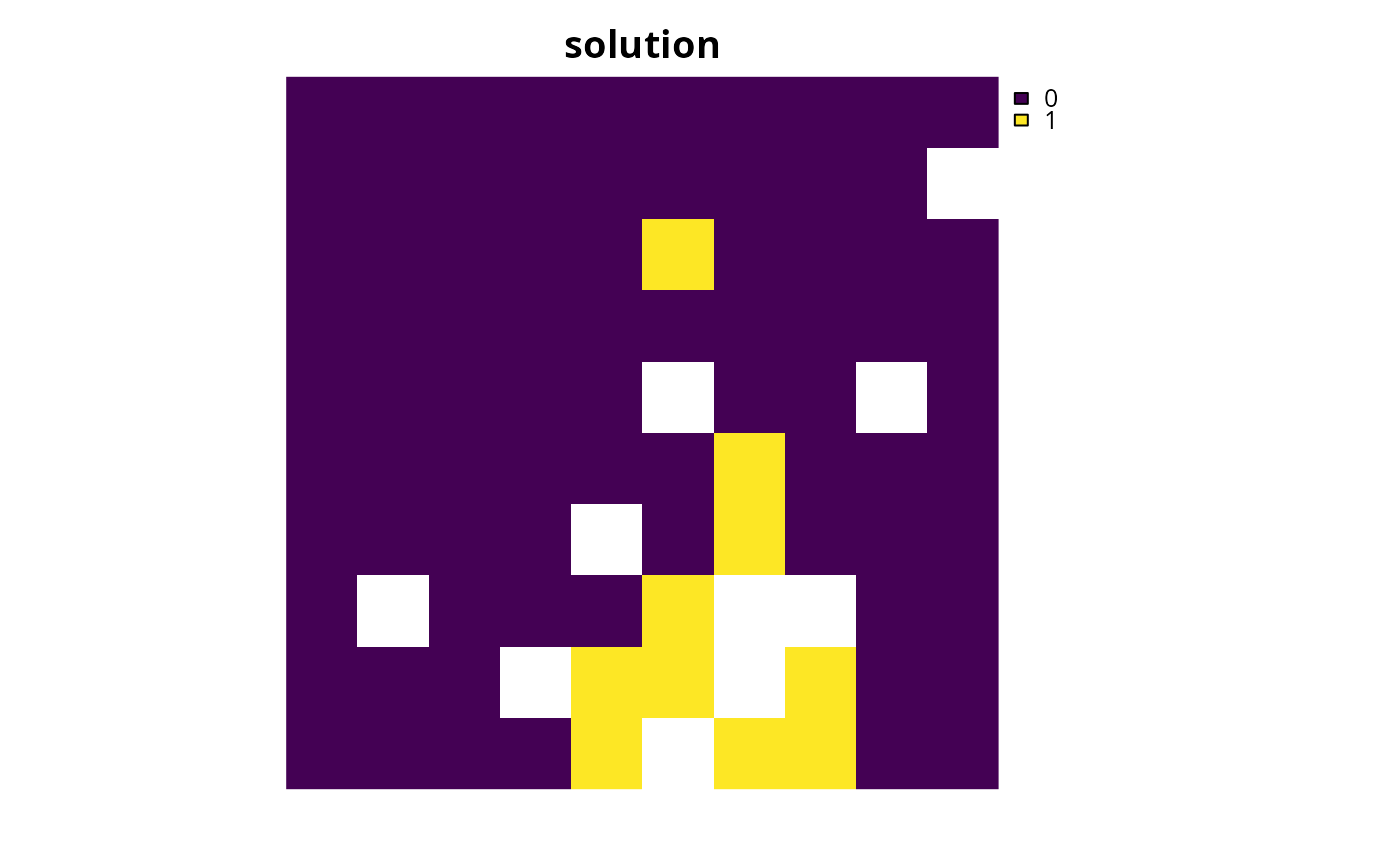
plot(s, main = "solution", axes = FALSE)