Add maximum weighted sum objective
Source:R/add_max_wtd_sum_objective.R
add_max_wtd_sum_objective.RdSet the objective of a conservation planning problem to maximize the weighted sum of the features represented by the solution as much as possible without exceeding a budget. This objective does not use targets, and feature weights should be used instead to increase the representation of particular features by a solution. Note that this objective does not account for complementarity and so often fails to produce solutions that represent a variety of different features (Kirkpatrick 1983). Although this objective can be valid when considering certain types of features (e.g., ecosystem services), we caution that it is not suitable for features that pertain to species distribution or ecosystem classification data. In general, we strongly advise against using this objective because – except under very specific conditions – it has "repeatedly been shown to identify priorities that are biologically ineffective and economically inefficient" (Brown et al. 2015).
Arguments
- x
problem()object.- budget
numericvalue specifying the maximum expenditure permitted for the solution. Ifxhas multiple zones, thenbudgetcan be (i) a singlenumericvalue to specify an overall budget for the entire solution or (ii) anumericvector to specify a budget for each zone (separately) in the solution. Ifxwill be used to generate a multi-objective problem (viamulti_problem()),budget = NULLcan be used to avoid specifying a maximum expenditure.
Details
The maximum weighted sum objective seeks to maximize the overall level of
representation across a suite of conservation features, while keeping cost
within a fixed budget.
Additionally, weights can be used to favor the
representation of particular features over other features (see
add_feature_weights()). It involves calculating scores
for each planning unit based on the feature data and weights,
and then selecting the combination of planning units that
would maximize the sum of these scores.
Please note that such scoring systems have considerable limitations
and – except in rare cases – are not suitable for modern systematic
conservation planning (Game et al. 2006).
We emphasize that this objective should not be used simply because you
do not have the time, data, or expertise to set meaningful targets.
Indeed, this objective should only be used if you have an expert-level
understanding of the limitations of this objective and are confident that
such limitations will not present issues for your conservation planning
exercise.
Mathematical formulation
This objective can be expressed mathematically for a set of planning units (\(I\) indexed by \(i\)) and a set of features (\(J\) indexed by \(j\)) as:
$$\mathit{Maximize} \space \sum_{j = 1}^{J} a_j w_j \\ \mathit{subject \space to} \\ a_j = \sum_{i = 1}^{I} x_i r_{ij} \space \forall j \in J \\ \sum_{i = 1}^{I} x_i c_i \leq B$$
Here, \(x_i\) is the decisions variable (e.g.,
specifying whether planning unit \(i\) has been selected (1) or not
(0)), \(r_{ij}\) is the amount of feature \(j\) in planning
unit \(i\), \(a_j\) is the amount of feature \(j\)
represented in in the solution, and \(w_j\) is the weight for
feature \(j\) (defaults to 1 for all features; see
add_feature_weights()
to specify weights). Additionally, \(B\) is the budget allocated for
the solution, and \(c_i\) is the cost of planning unit \(i\).
Notes
In early versions (< 9.0.0.0), this function was named as
the add_max_cover_objective() and the add_max_utility_objective()
function. It has since been renamed for clarity.
Additionally, in previous versions (< 9.0.0), this function had extra
terms to help minimize the solution cost. Although these terms
have since been removed to reduce solve time,
this behavior can still be achieved by
building a multi-objective optimization problem and specifying the
first problem based on this objective function and the second
problem based on minimizing cost penalties (i.e., by using
add_min_penalties_objective() and add_cost_penalties()).
References
Brown CJ, Bode M, Venter O, Barnes MD, McGowan J, Runge CA, Watson JEM, and Possingham HP (2015) Effective conservation requires clear objectives and prioritizing actions, not places or species. Proceedings of the National Academy of Sciences 112: E4342.
Game ET, Kareiva P, and Possingham HP (2013) Six common mistakes in conservation priority setting. Conservation Biology, 27: 480–485.
Kirkpatrick JB (1983) An iterative method for establishing priorities for the selection of nature reserves: An example from Tasmania. Biological Conservation, 25: 127–134.
See also
See objectives for an overview of all functions for adding objectives.
Also, see add_feature_weights() to specify weights for different features.
Other functions for adding objectives:
add_max_cover_objective(),
add_max_n_targets_met_objective(),
add_max_phylo_div_objective(),
add_max_phylo_end_objective(),
add_min_largest_shortfall_objective(),
add_min_penalties_objective(),
add_min_set_objective(),
add_min_shortfall_objective()
Examples
# load data
sim_pu_raster <- get_sim_pu_raster()
sim_features <- get_sim_features()
sim_zones_pu_raster <- get_sim_zones_pu_raster()
sim_zones_features <- get_sim_zones_features()
# create problem with maximum utility objective
p1 <-
problem(sim_pu_raster, sim_features) %>%
add_max_wtd_sum_objective(5000) %>%
add_binary_decisions() %>%
add_default_solver(gap = 0, verbose = FALSE)
#> ℹ `add_max_wtd_sum_objective()` has severe limitations - use with caution.
# solve problem
s1 <- solve(p1)
# plot solution
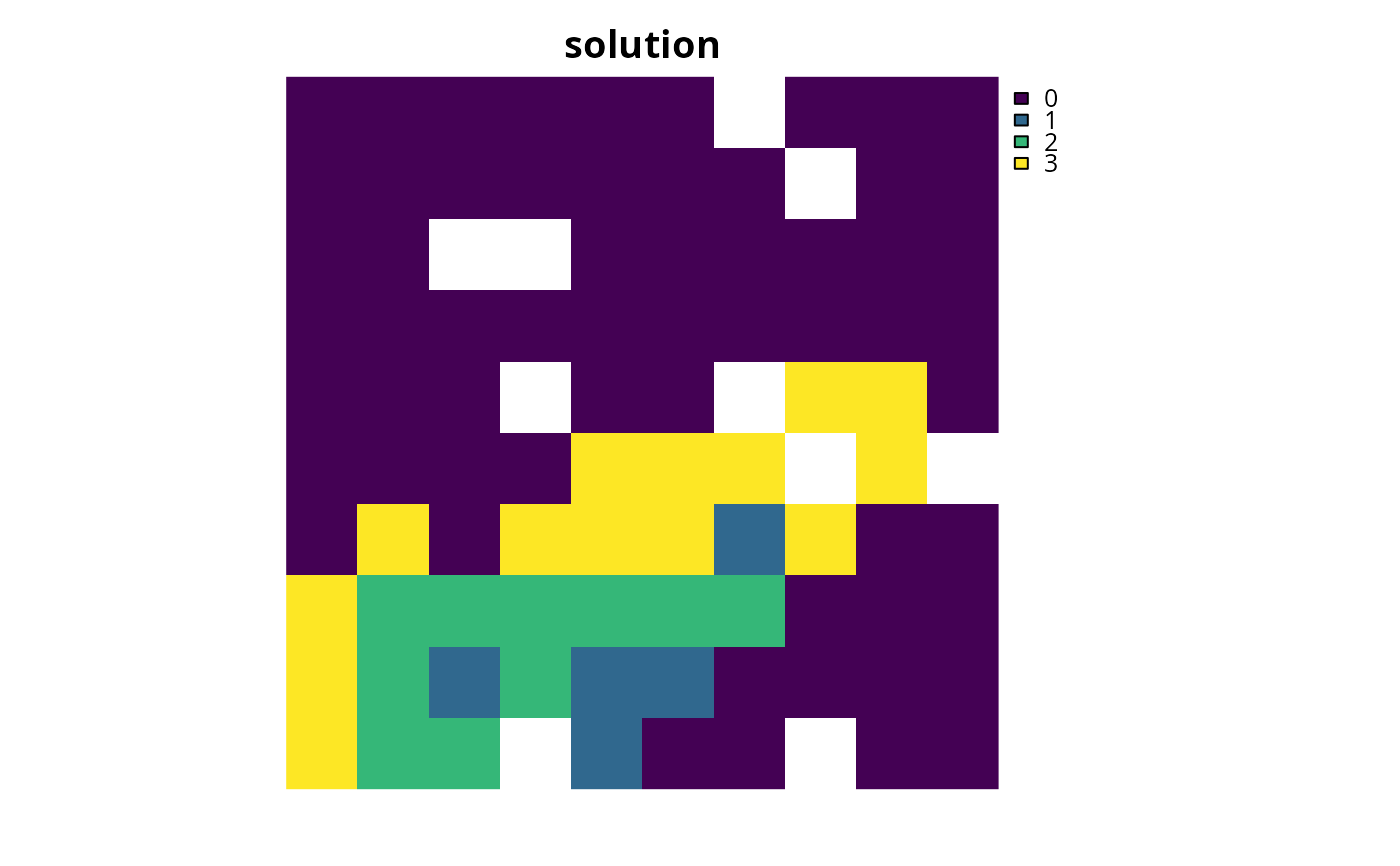
plot(s1, main = "solution", axes = FALSE)
 # create multi-zone problem with maximum utility objective that
# has a single budget for all zones
p2 <-
problem(sim_zones_pu_raster, sim_zones_features) %>%
add_max_wtd_sum_objective(5000) %>%
add_binary_decisions() %>%
add_default_solver(gap = 0, verbose = FALSE)
#> ℹ `add_max_wtd_sum_objective()` has severe limitations - use with caution.
# solve problem
s2 <- solve(p2)
# plot solution
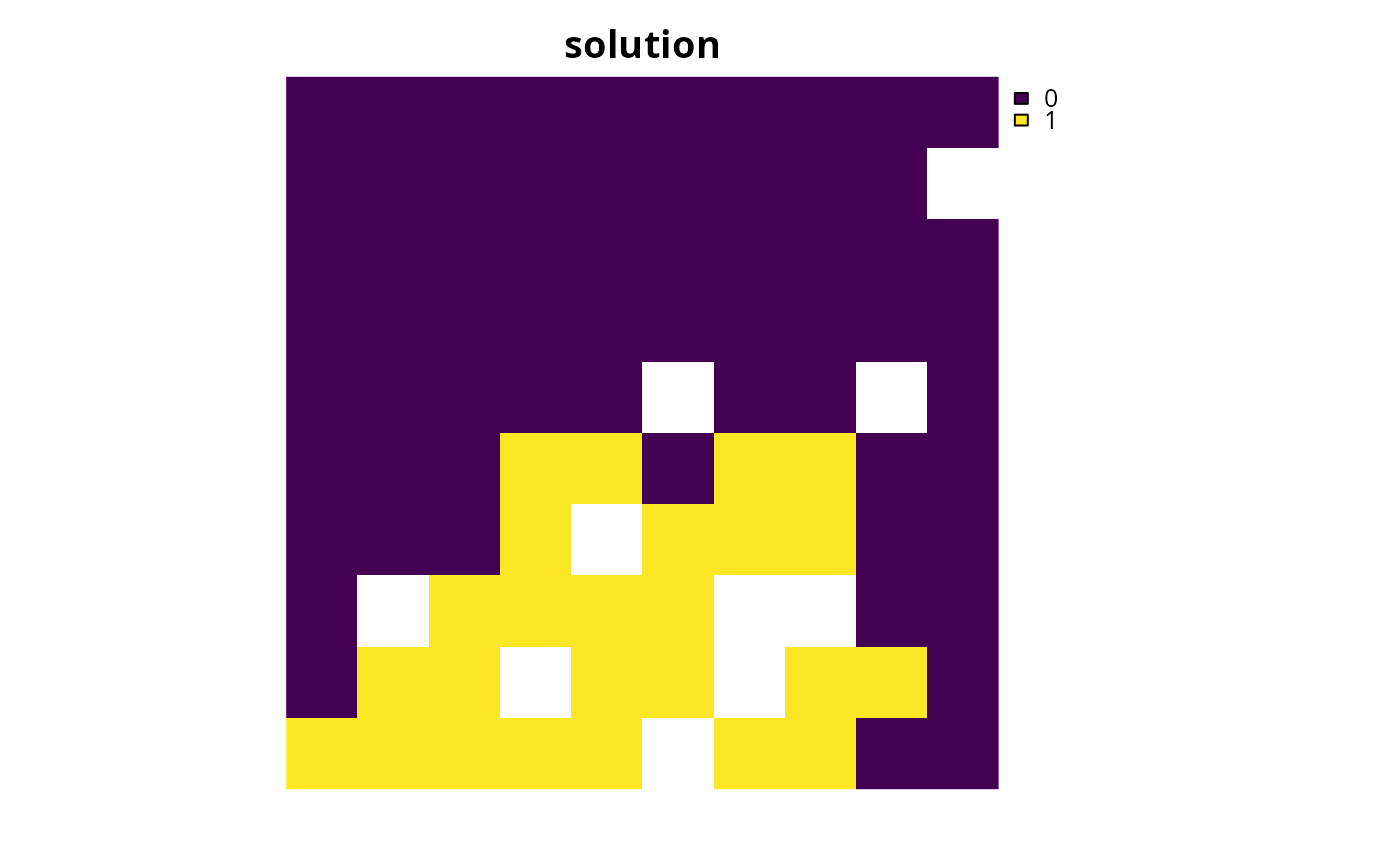
plot(category_layer(s2), main = "solution", axes = FALSE)
# create multi-zone problem with maximum utility objective that
# has a single budget for all zones
p2 <-
problem(sim_zones_pu_raster, sim_zones_features) %>%
add_max_wtd_sum_objective(5000) %>%
add_binary_decisions() %>%
add_default_solver(gap = 0, verbose = FALSE)
#> ℹ `add_max_wtd_sum_objective()` has severe limitations - use with caution.
# solve problem
s2 <- solve(p2)
# plot solution
plot(category_layer(s2), main = "solution", axes = FALSE)
 # create multi-zone problem with maximum utility objective that
# has separate budgets for each zone
p3 <-
problem(sim_zones_pu_raster, sim_zones_features) %>%
add_max_wtd_sum_objective(c(1000, 2000, 3000)) %>%
add_binary_decisions() %>%
add_default_solver(gap = 0, verbose = FALSE)
#> ℹ `add_max_wtd_sum_objective()` has severe limitations - use with caution.
# solve problem
s3 <- solve(p3)
# plot solution
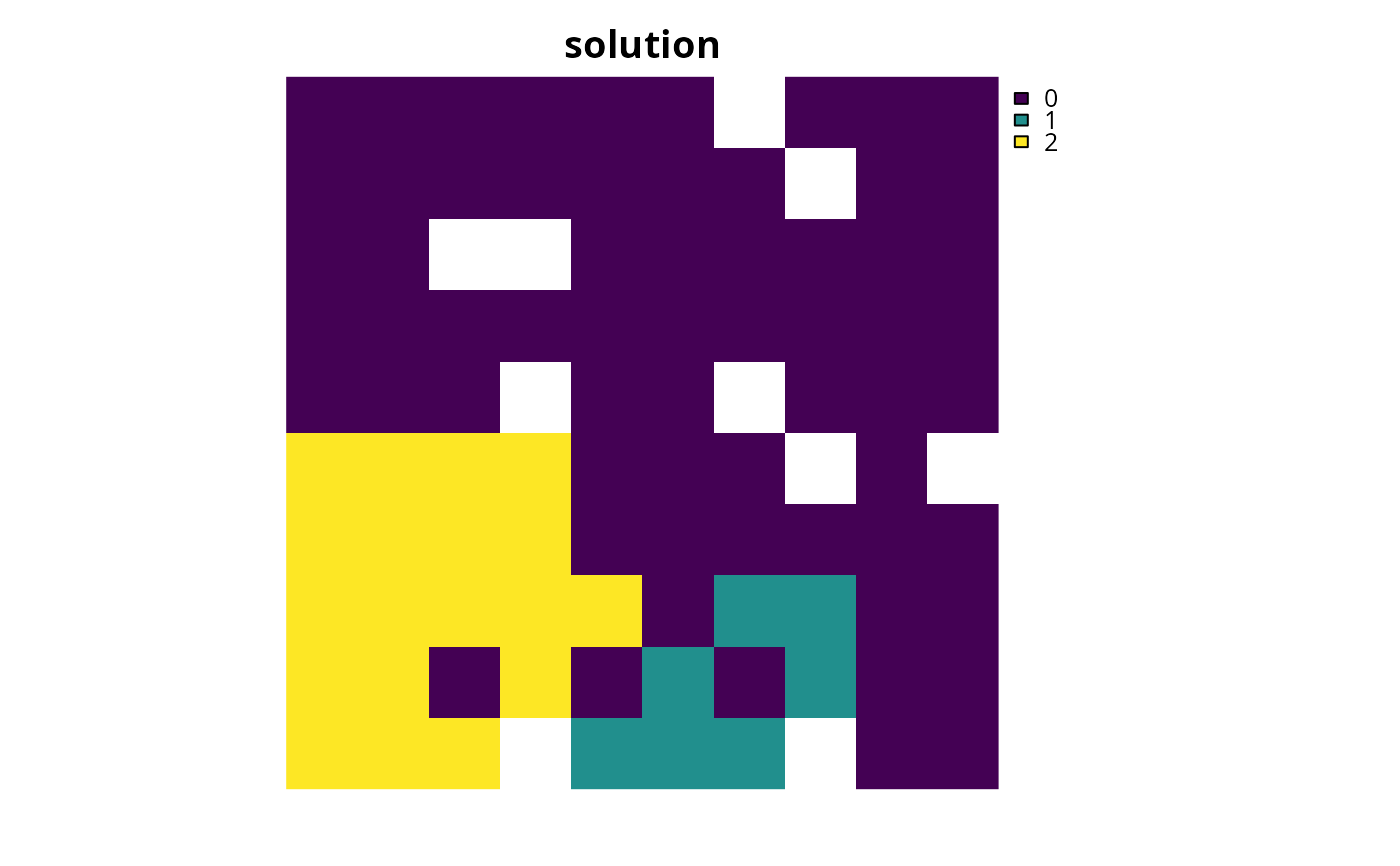
plot(category_layer(s3), main = "solution", axes = FALSE)
# create multi-zone problem with maximum utility objective that
# has separate budgets for each zone
p3 <-
problem(sim_zones_pu_raster, sim_zones_features) %>%
add_max_wtd_sum_objective(c(1000, 2000, 3000)) %>%
add_binary_decisions() %>%
add_default_solver(gap = 0, verbose = FALSE)
#> ℹ `add_max_wtd_sum_objective()` has severe limitations - use with caution.
# solve problem
s3 <- solve(p3)
# plot solution
plot(category_layer(s3), main = "solution", axes = FALSE)